Clean Ocean Action's 10 Tips Series
Clean Ocean Action developed a series of "tip cards" designed to educate distinct groups of people. These cards teach people how they can minimize their contribution to the problem of non-point source pollution or "pointless pollution". Aimed at specific user groups (e.g. drivers, boaters, homeowners, etc.) COA has found the cards to be excellent educational tools to broadcast the pointless pollution message. The cards are available for municipalities to reproduce and distribute in town mailings or billings to residents. The cards could also be printed in the community newspaper, or posted in town buildings or community bulletin boards. Copies of the individual cards are listed below.

New Google Slide Presentation! Tips for Summertime Eco-friendly Party Planning, Picnics, and Play
NON-POINT SOURCE POLLUTION
Non-point source or "pointless" pollution is the primary threat to coastal water quality. It includes runoff of litter from the streets, fertilizers, pesticides, pet waste, leaky septic systems, and faulty sewage and stormwater systems. People and their everyday habits are both the source and solution to this problem. By keeping informed and making small changes, you can help make our oceans fish-able and swim-able. Remember, whatever goes down a drain, down a storm sewer, into a gutter, on a lawn, or in the air, eventually ends up in the ultimate "sink"... our ocean. |
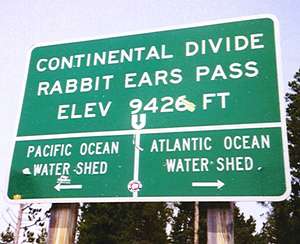
The Continental Divide, which runs through the Rocky Mountains of Colorado (shown here at Rabbit Ears Pass near Steamboat), is the ultimate North American watershed boundary. Rain that falls in its vicinity either runs off to the west (eventually to the Pacific Ocean) or to the east (eventually to the Atlantic Ocean). That means that runoff from places as faraway as eastern Colorado or New Mexico eventually winds up in the Atlantic Ocean.